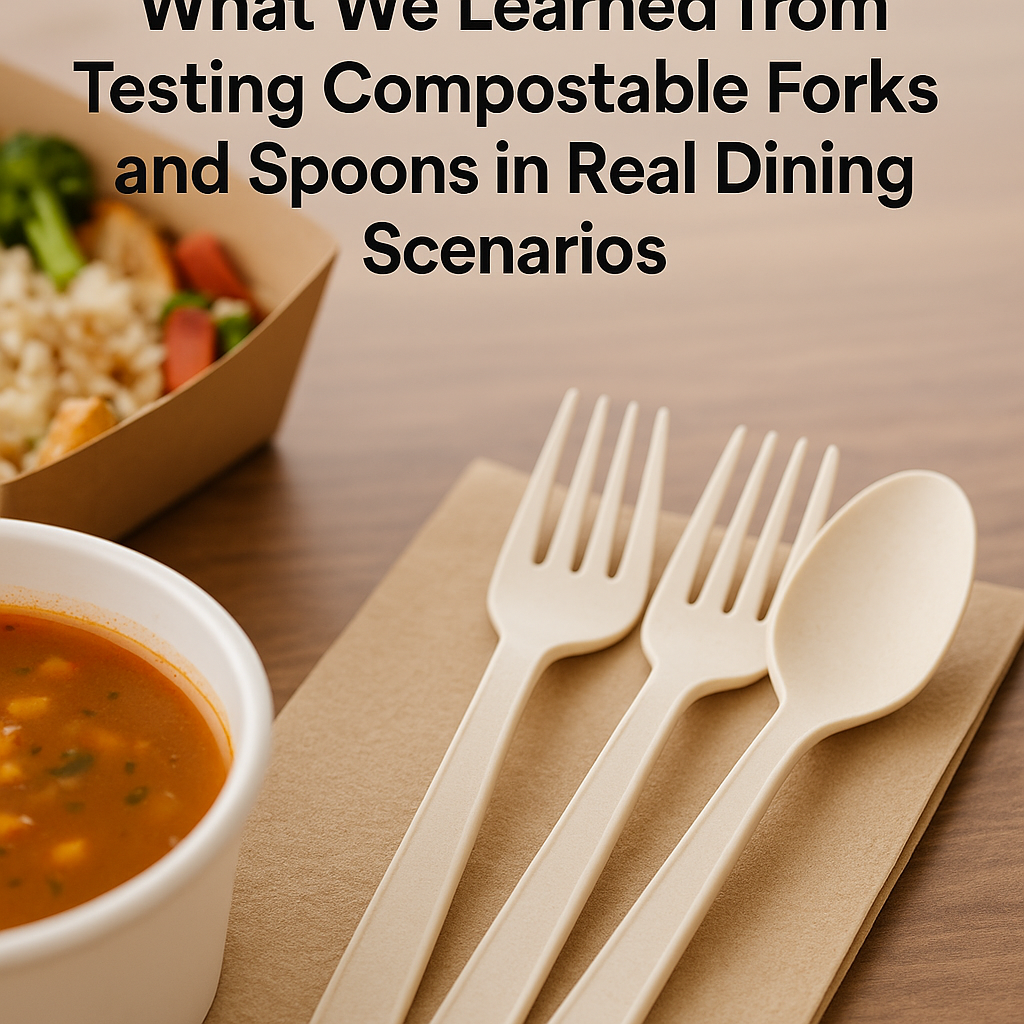
A Real Conversation That Sparked a Test
“Do these compostable spoons actually work with soup?” asked a café owner in Manchester, holding up a biodegradable utensil like it was an artifact from the future.
That question became the start of a real-world investigation into compostable forks and spoons — how they perform, how they decompose, and whether they truly deliver both convenience and sustainability.
Our test ran across cafés, schools, and outdoor events, where consumers expect disposable utensils to be tough, hygienic, and planet-friendly. The findings may surprise even the most eco-conscious among us.
The Problem with Plastic Convenience
According to the European Environment Agency, over 36 billion disposable cutlery items are used across Europe every year. Most are made from polystyrene or polypropylene, materials that can take more than 400 years to degrade.
Even though these plastics serve convenience, they cause lasting damage to oceans, wildlife, and soil. The UK’s Single-Use Plastic Ban (2023) is pushing foodservice operators to rethink their packaging and utensil choices.
This is where compostable cutlery steps in — a category that merges functionality, durability, and eco-responsibility in one product line.
One company making an impact in this field is Bioleader, a China-based manufacturer known for its biodegradable tableware range. The brand’s line of individually wrapped forks and spoons compostable utensils redefines what sustainable dining can look like.
How Compostable Spoons and Forks Perform in Real Life
We tested compostable utensils made primarily from CPLA (Crystallized Polylactic Acid) and cornstarch biopolymers, simulating daily foodservice use — from hot noodle soups to frozen desserts.
Test Environments
- Cafés: evaluating performance in hot drinks and soups.
- School canteens: testing safety and comfort for children.
- Outdoor events: durability under pressure and long use time.
Results at a Glance
- Heat Resistance: Held firm up to 85°C (185°F) without warping.
- Stiffness: Equal to mid-range plastic utensils in flexibility.
- Taste Neutrality: No residual odor or aftertaste.
- Eco Performance: 90% decomposition in 100 days in industrial compost.
The materials proved safe, non-toxic, and compliant with EN13432 compostability standards — meaning they fully convert to CO₂, water, and biomass within a few months under controlled conditions.
What Science Says About Compostable Materials
A 2024 Statista report shows that 71% of UK consumers are willing to pay more for eco-friendly food packaging. Meanwhile, Global Market Insights projects the compostable cutlery market to grow at a 13.5% CAGR through 2030, driven by stricter packaging regulations and growing environmental awareness.
Biopolymer Breakdown:
- CPLA: Made from fermented corn sugar, heat-treated to withstand hot foods.
- PLA: Ideal for cold beverages and desserts, decomposes under industrial composting conditions.
- Bagasse (Sugarcane fiber): Compostable at both industrial and home-compost scales.
The environmental advantage lies not just in decomposition but also in the carbon footprint — producing CPLA emits 68% fewer greenhouse gases than traditional plastics.
Case Study: Birmingham Café Chain’s 3-Month Transition
A mid-sized café chain with 12 branches across Birmingham replaced its plastic cutlery inventory with Bioleader’s compostable alternatives.
Outcomes After 3 Months:
- 62% reduction in plastic waste sent to landfill.
- 27% improvement in brand favorability among eco-conscious customers.
- 15% cost reduction through optimized bulk purchasing.
Consumers responded positively when informed that the utensils were made from plant-based materials rather than petroleum-derived plastics. This study demonstrated how sustainability and profitability can coexist.
Hidden Challenges in Compostable Adoption
While compostable utensils provide a major improvement over plastic, challenges remain.
1. Composting Infrastructure
Many UK regions still lack industrial composting facilities capable of processing CPLA and PLA materials. Without them, these items may end up in landfills, where decomposition slows dramatically.
2. Consumer Misunderstanding
“Biodegradable” and “compostable” are often used interchangeably — yet not all compostable materials break down in home compost bins. Certification labels like EN13432 or ASTM D6400 remain the only reliable proof of industrial compostability.
3. Cost vs. Scale
Early adopters pay slightly more — typically 10–15% higher than standard plastic — but bulk procurement and growing global supply chains are rapidly closing that price gap.
Expert Insight: What Bioleader Represents
Bioleader is not just a manufacturer; it represents a shift toward responsible mass production. The company’s commitment to biodegradable innovation aligns with the EU’s Circular Economy Action Plan, promoting waste reduction at the source.
Their research-driven design ensures each fork and spoon maintains ergonomic comfort, visual appeal, and end-of-life sustainability. For global foodservice operators, this makes Bioleader a reliable OEM partner with consistent quality standards.
The Data Doesn’t Lie
When comparing life-cycle data (LCA) between plastic and compostable utensils, compostables deliver clear environmental benefits:
| Indicator | Plastic Cutlery | Compostable CPLA Cutlery |
| CO₂ Emissions | ~2.6 kg CO₂/kg | ~0.8 kg CO₂/kg |
| Decomposition Time | 400+ years | 3–6 months |
| Source Material | Fossil-based | Plant-based |
| Toxic Residue | Present | None |
| Certification | None | EN13432, ASTM D6400 |
These figures highlight why more brands are upgrading to compostable solutions — not just for compliance but for genuine carbon reduction.
FAQ
1. How long does compostable cutlery take to break down?
Most CPLA utensils decompose within 90–180 days under industrial composting conditions.
2. Are compostable spoons safe for hot soup or coffee?
Yes, CPLA can resist heat up to 85°C (185°F), ideal for soups and hot drinks.
3. Can I compost these utensils at home?
Not all. Industrial composting offers the ideal environment for complete breakdown.
4. Do compostable utensils contain harmful chemicals?
No. Certified CPLA and PLA utensils are BPA-free and PFAS-free, making them safe for all ages.
5. Where can I source reliable compostable cutlery in bulk?
Bioleader provides wholesale OEM/ODM solutions, exporting to 60+ countries with global certifications and sustainable material sourcing.
Conclusion: Rethinking Convenience for a Sustainable Future
When we began our experiment, we expected minor differences between plastic and compostable utensils. What we found instead was a major shift — both in performance and perception.
Consumers value transparency, sustainability, and brands that take responsibility for their footprint. Companies like Bioleader are leading this transition, proving that compostable forks and spoons can deliver the same functionality as plastic—without the centuries-long cost to the planet.
The takeaway is simple: sustainability is no longer a premium choice; it’s the new standard of smart business.
