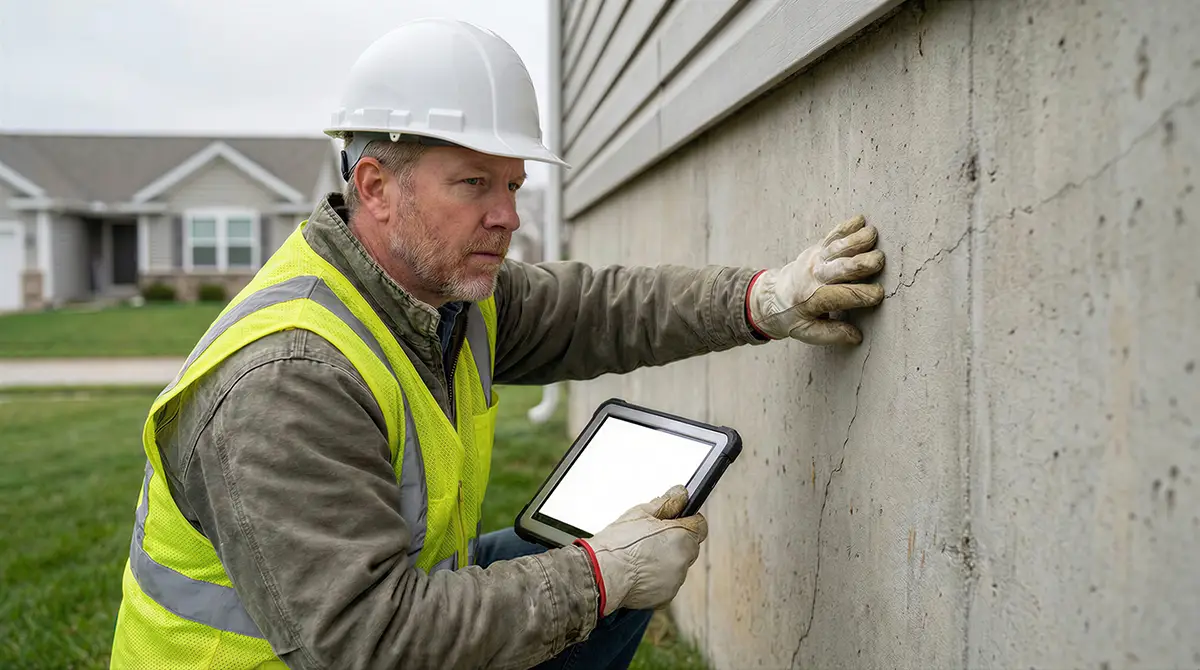
Most houses move a little. Timber swells and shrinks with the seasons, plaster dries out, and new builds settle as the ground adjusts to their weight. That background movement is normal, and the fine cracks it leaves are rarely a cause for concern. Foundation problems are different. They tend to develop slowly, show up in several places at once and worsen over time, and the cost of putting them right usually rises the longer they are ignored.
Knowing what to look for, what tends to cause the trouble and which repairs are commonly used makes it far easier to judge when a crack can simply be filled and painted, and when it is time to call in a structural engineer or chartered surveyor.
Warning Signs to Look Out For
- Stair-step cracks in brickwork: Cracks that zigzag diagonally through the mortar joints of an external wall, like a flight of steps, are a classic sign of foundation movement. They show that one part of the wall has dropped or lifted relative to another. Note whether the crack is wider at the top or the bottom, as this hints at the direction of movement. Cracks that run through the bricks themselves, rather than just the mortar, suggest greater force.
- Cracks around doors and windows: Openings are weak points in a wall, so stress tends to show there first. Diagonal cracks running from the corners of window frames or door heads, inside or out, are worth recording.
- Sticking doors and windows: A door that used to close easily but now catches on its frame, or a sash window that jams, can mean the opening has been pulled out of square. Damp weather makes timber swell, so look for a pattern. If several doors on the same side of the house start sticking at once, movement is a more likely explanation than humidity.
- Sloping or uneven floors: A marble that rolls steadily to one side of a room, a noticeable dip near an external wall or floor tiles cracking in a line can all point to movement below. Suspended timber floors can also sag for other reasons, such as rotten joists, so this sign needs investigating rather than assuming.
- Gaps and separation: Watch for gaps opening between skirting boards and the floor, between walls and ceilings, or where an extension, bay window or porch joins the main house. A chimney stack that has begun to lean, or a conservatory pulling away from the wall it was built against, falls into the same category.
What Causes Foundation Movement
- Clay shrinkage and heave: Clay soils are a common culprit in the UK, particularly across parts of south-east England. Clay shrinks as it dries and swells as it wets, so a long, dry summer can cause the ground under a house to contract and the foundations to drop, a process known as subsidence. The reverse, called heave, happens when clay takes on water and expands, sometimes after a large tree has been removed and the ground slowly rehydrates.
- Trees and vegetation: Large trees close to a building draw a great deal of moisture from the soil, which intensifies clay shrinkage during dry spells. Thirsty species growing near older properties with shallow footings are a frequent factor in subsidence. Felling a mature tree is not automatically the answer, though, because of the heave risk described above.
- Leaking drains and poor drainage: Water escaping from a cracked drain or broken downpipe can soften the ground, or wash fine particles out of sandy soils and leave voids beneath the foundation. Blocked gutters, downpipes that discharge against a wall and paving that falls towards the house all concentrate water exactly where it does the most harm.
- Shallow or poorly built foundations: Older houses were often built on shallow footings that would not meet modern standards, and some properties sit on made ground or backfill that compacts over time. For a broader overview of how different foundation types transfer a building’s load into the ground, the Wikipedia article on foundation engineering is a useful starting point.
Cosmetic or Structural?
Not every crack spells trouble. Fine hairline cracks in plaster, especially where walls meet ceilings or around fresh plasterwork, usually come from drying shrinkage or minor thermal movement. As a broad rule of thumb, building professionals grade cracks by width, and those under about a millimetre are generally treated as cosmetic. Cracks wider than a few millimetres, cracks that taper, cracks that keep growing and cracks accompanied by other symptoms deserve a proper assessment.
The simplest way to tell whether movement is ongoing is to monitor it. Mark the ends of a crack in pencil with the date, or fix a crack-monitoring gauge across it, and check every few weeks. Seasonal opening and closing often points to clay shrinkage linked to nearby vegetation, while steady widening suggests a progressive problem. Dated photographs with a ruler held alongside will help an engineer or your buildings insurer.
If you suspect subsidence, contact your insurer early. Many buildings policies cover it, and insurers often prefer to arrange the investigation themselves.
Common Repair Approaches
The right fix depends on the cause, the soil and the type of construction, so structural work should always follow a proper diagnosis. Reading a few foundation repair guides before you collect quotes will help you follow what an engineer proposes, but the outline below covers the methods you are most likely to hear about.
- Underpinning and piering: Where the soil beneath a foundation cannot support it, underpinning extends the foundation down to firmer ground. Traditional mass concrete underpinning involves excavating in short sections beneath the existing footing and filling each with concrete. Piled systems, which use steel or concrete piles driven or screwed down to a load-bearing layer and connected to the building with beams or brackets, suit sites where good ground lies deeper. These are significant works that require an engineer’s design and building regulations approval.
- Slab lifting and resin injection: Sunken concrete slabs can sometimes be raised rather than replaced. Slabjacking pumps a cement-based grout beneath the slab through drilled holes, while newer methods inject expanding polyurethane foam that fills voids, compacts loose soil and gently lifts the slab back towards level. Resin injection is far less disruptive than excavation, though it suits some ground conditions better than others.
- Crack injection and stitching: Once movement has stopped, or its cause has been dealt with, cracks can be repaired. Epoxy injection can structurally bond a cracked concrete wall back together, while flexible polyurethane injection is often used to seal cracks against water. In brickwork, helical stainless steel bars are bonded into the mortar joints across a crack to tie the masonry together, a technique known as crack stitching.
- Drainage repairs: Because water is so often the trigger, fixing drainage is one of the most effective measures available. A CCTV drain survey can reveal cracked or displaced pipes, which can then be relined or replaced. Clearing gutters, extending downpipes away from walls and re-grading paths so water runs away from the house all help keep soil moisture more stable.
- Waterproofing: Basements and cellars affected by movement often suffer from damp and water ingress too. Remedies include cementitious tanking applied to the walls, a cavity drain membrane that channels water to a sump, or a combination of both. Waterproofing will not cure a structural fault, but it protects the interior once the structure has been stabilised.
Getting the Order Right
The most common mistake with foundation problems is treating the symptom before the cause. Filling a crack that is still moving simply hides the evidence, and lifting a slab without repairing the leaking drain beneath it invites the same failure again. Record what you see, monitor any cracks over a few months, and speak to a qualified professional if the signs point to structural movement. Caught early, most foundation issues can be resolved with far less disruption than homeowners fear.
